
Payroll fraud (also called worker misclassification and workplace fraud) is the illegal practice of designating an employee as a "1099 worker" or an independent contractor. Unscrupulous employers do this to avoid paying payroll taxes, unemployment tax, or workers’ compensation insurance and are therefore able to submit lower bids for projects, undercutting responsible contractors. Several states have already passed laws to penalize those who cheat workers and taxing agencies in this way, and two bills are currently being considered which would provide federal legislation to end this practice and that of wage theft. They are The Fair Playing Field Act, introduced by Senator Kerry and a number of co-sponsors and The Employee Misclassification Prevention Act.

Construction in Texas may be "cheap," but that's only if you consider the final price of the project. In most cases, the true costs are borne by workers, taxpayers, and society at large. Case in point: WFAA's David Schecter, a quality journalist who exposed worker misclassification in a North Texas school district, this week took the time to highlight the story of Guillermo Mata.

From WFAA:

In December, Mata shattered his leg after falling from the second story onto a concrete floor at construction site in Irving.

"Take me to Parkland (hospital),” Mata recalls saying after the injury.

Florida legislators have made a bold move in the battle against payroll fraud with the passing of Florida House Bill 217 titled “Money Services Businesses”.  Aimed directly at the bandits who run check cashing stores to enable dishonest contractors to avoid paying workers’ compensation and payroll taxes, the bill is now on its way to Governor Rick Scott for his signature into law.  The details of the bill were explained in a press release from the Florida Office of Financial Regulation (OFR).

“The new legislation will require check cashers to log any checks cashed in excess of $1,000.  In addition to the check amount, each business will be required to submit traceable information such as payor, payee, fee charged, type of identification presented and payee’s workers’ compensation insurance policy number, if the check was made out to a business.  The bill also provides that multiple checks accepted from any one person in one day, which total $1,000 or more, must be aggregated and reported in the database.”

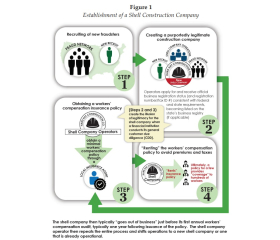
Readers of Construction Citizen have already been informed about how these check cashing store / workers’ comp fraud schemes work, but here it is again.  A dishonest contractor will submit a bid for a job using a company name which lists only a few employees – just enough to obtain a small workers’ compensation policy.  The contractor will then take checks paid to that company by the general contractor to a check cashing store to cash them so that most of the workers can be paid in cash.  Read more » about Check Cashing Payroll Fraud Scheme Thwarted in Florida

After months of forward momentum, a proposed crackdown on misclassification of construction workers championed by both business and labor may have hit a serious snag.

The bill by Representative John Davis, R-Houston, would create penalties for companies that are found to be intentionally misclassifying their workers. Despite the fact that it was passed unanimously by a committee, it has yet to be placed on the calendar for a vote by the full House of Representatives. Our sources in the capitol say members of the powerful House Calendars Committee are under pressure from home builders who testified against it to keep the bill off the House floor. Make no mistake: It is crunch time for passing bills in this legislative session. Read more » about Misclassification Crackdown Stalls in Texas House

The bill still has a long way to go, but the proposed crackdown on the intentional misclassification of construction workers in Texas passed a milestone last week when it was voted unanimously out of a House Committee.

On a 7-0 vote, HB 1925 was sent to the full Texas House. Before it can get to the House floor for a vote, however, it has to be put on the House calendar by the Calendars Committee. This is a step in the process where many bills can die. With time running short in the legislative session, the Calendars Committee has the power to keep legislation, good or bad, from getting to the point where the representatives of the people get to decide the issue. I'm told that Calendars Committee Chairman Todd Hunter may be coming under pressure from opponents of the crackdown, including the largest homebuilders: Read more » about Worker Misclassification Crackdown Passes House Committee

A federal grand jury in Kansas City, Kansas has charged a construction company, its owners, and four of its crew leaders with harboring illegal aliens and money laundering, charges which could bring the defendants up to 20 years in federal prison each and fines up to $250,000 per convicted count.  Advantage Framing Systems, Inc. of Spring Hill, Kansas, company owners James and Kimberly Humbert and Charles Stevens II, and four framing crew leaders for the company – Jose Ramon Caro-Corral, Angel Arguello-Plata, Dennis Ericson Portillo and Jorge Uriel Delgado-Ovalle are all charged with committing these crimes as part of a scheme to hire illegal workers in order to gain a competitive advantage over other contractors and boost their own profits.

A press release by the United States Attorney’s Office for the District of Kansas explained how the company allegedly conducted business:

“The indictment alleges James Humbert, Kimberly Humbert, Charles Stevens and the company itself were responsible for hiring undocumented workers for the purpose of lowering the company’s operating costs.  The wages the company paid did not include the employer’s share of Social Security payments, workers compensation, or unemployment insurance benefits paid to lawfully employed workers in the construction industry.  They placed themselves at a competitive advantage to other builders who did not employ undocumented workers.   Read more » about Framing Company Charged with Hiring Illegal Aliens To Cut Costs

Major Texas homebuilders came out against the state's moves toward cracking down on worker misclassification during a legislative hearing on Wednesday. The Leading Builders of America, which represents Perry Homes, David Weekley Homes, and others, argued that putting new regulations in place for the industry would lead to higher home prices and stifle job creation.

Steve Henry, speaking for the Leading Builders of America, the trade group that represents Perry and Weekley, said the crackdown on payroll fraud would not only lead to increased home prices, but it would also increase litigation, deter the creation of small businesses and stifle job creation. Andrew Turner, representing the same trade group, said it is a "confusion of an already confusing area of the law." He said the Workforce Commission already has the ability to deal with misclassification. “It’s not fair to single out this industry,” he said. He said that if the legislation were passed, more people would have to be paid as employees instead of independent subcontractors. Read more » about Sparks Fly at the Capitol Over Misclassification Crackdown

In the second installment of his excellent series on the Texas construction industry, NPR Correspondent Wade Goodwyn highlights the difference between contractors who play by the rules, like Marek Brothers Systems in Houston, and companies that misclassify their employees.  The former is out front with how they do business, and the latter doesn't even want their name used on the radio or in print.

From the report:

At Baylor College of Medicine in Houston, Marek's workers are building the interior for the hospital's newest wing.  Workers ride around on what are called “motorized man lifts”, which allow them to work high in the air, power tools in hand.

Baylor Hospital is the kind of client that hires Marek's companies – an owner that must have its building done to exacting specifications.  But these days that’s unusual, according to Stan Marek.   Read more » about NPR: Texas Contractors Say Playing By The Rules Doesn't Pay

On today's installment of NPR's Morning Edition, correspondent Wade Goodwyn put the microscope on the Texas construction industry and what he found was disturbing. Click here to listen to the story.

From his report:

If wage theft is a nasty cousin of slavery...there's a deeper, more fundamental sickness affecting the Texas construction industry: the misclassification of construction workers as independent contractors instead of as employees.

The state of Utah is fighting worker misclassification in the construction industry by scrutinizing employment records of companies who hire limited liability corporations, or LLCs.  Some dishonest contractors avoid paying their workers as employees by having each of them register as separate LLCs, claiming on paper at least that each worker is a company owner or independent contractor.

Two years ago the state legislature created an enforcement council consisting of representatives from the state’s Labor Commission, Department of Commerce, Tax Commission, Department of Workforce Services and the Utah attorney general.  The council meets monthly to share information about construction companies in order to identify and stop worker misclassification, or payroll fraud.  The 2013 legislature has now authorized the continuation of the Worker Classification Coordinated Enforcement Council for the next three years.

The Utah Division of Occupational and Professional Licensing (DOPL) is in charge of enforcing state licensing rules for construction companies.  This week, an article in the Salt Lake Tribune explained how these rules provide one way for contractors who commit payroll fraud to be caught.  The article states:

“Changes in 2011 tightened definitions of employees and owners for licensed construction companies, set new reporting rules and provided for state auditing to verify financial responsibility.  Licensing disclosure rules give officials a crucial glimpse into how companies operate, as well as a squeeze point when their practices are out of bounds.”   Read more » about Not An Employee, LLC

There's still plenty of work to do, but supporters of a crackdown on payroll fraud in Texas got a big boost yesterday when the Texas Association of Business (TAB) said it would not oppose the effort. Cathy DeWitt with TAB said in a House hearing that the powerful business group agrees with the concept, but they have some problems with the bill filed by Representative Joe Deshotel, D-Beaumont.

Among other things, DeWitt said the amount of fines for payroll fraud shouldn't be written into a new law, but instead the Texas Workforce Commission (TWC) should use its rulemaking process and take complaints on a case-by-case basis. 

I spoke with Representative Deshotel after the hearing and he said he has a lot of work to do when it comes to coordinating with the TWC on this issue. "I will keep visiting with them. We have to deal with what we have. I've been working with TAB and you know the other people who testified, and I think it's an enforcement issue Read more » about Texas House Holds First Hearing on Payroll Fraud

Pages